Page Logo

QUDT - Quantities, Units, Dimensions and Data Types in OWL and XML

September 11, 2011

Authors:
Ralph Hodgson <Ralph.Hodgson at nasa.gov>
Paul J. Keller <Paul.J.Keller at nasa.gov>

Overview

Status of This Document

This document and the related ontologies are currently published as Version 1.1. Work on additional units and quantites continues and the documentation and release of ontologies will be improved incrementally.

Background

The QUDT Ontologies, and derived XML Vocabularies, are being developed by TopQuadrant and NASA. Originally, they were developed for the NASA Exploration Initiatives Ontology Models (NExIOM) project, a Constellation Program initiative at the AMES Research Center (ARC). The goals of the QUDT ontology are twofold:

  • to provide a unified model of, measurable quantities, units for measuring different kinds of quantities, the numerical values of quantities in different units of measure and the data structures and data types used to store and manipulate these objects in software;
  • to populate the model with the instance data (quantities, units, quantity values, etc.) required to meet the life-cycle needs of the Constellation Program engineering community.
  • QUDT Ontologies

    The QUDT public site is currently only publishing the foundation ontologies and vocabularies and some examples from engineering disciplines.

    The current release of the QUDT ontologies is version 1.1 and may be downloaded from the QUDT Catalog at LinkedModel.org.


    Ontology Class Structure

    The diagram below, exported from TopBraid Composer, illustrates the main class structure of the QUDT ontology in OWL.

    Quantities, Quantity Kinds, and Quantity Values

    A Quantity is an observable property of an object, event or system that can be measured and quantified numerically. Quantities are differentiated by two attributes which together comprise the essential parameters needed to formalize the structure of quantities: kind and magnitude. The kind attribute of a quantity identifies the observable property quantified, e.g. length, force, frequency; the magnitude of the quantity expresses its relative size compared to other quantities of the same kind.

    For example, the speed of light in a vacuum and the escape velocity of the Earth are both quantities of the kind speed but are of different magnitudes. The speed of light in a vacuum is greater than the escape velocity of the Earth. More generally, the speed of light in a vacuum is comparable to the escape velocity of the Earth. Thus, if two quantities are of the same kind, their magnitudes can be compared and ordered. However, the same is not true if the quantities are of different kinds. There is no intrinsic way to compare the magnitude of a quantity of mass with the magnitude of a quantity of length.

    Quantities may arise from definition or convention, or they may be the result of one or a series of experiments and measurements. In the first case, the quantity is exact; in the second case, measurement uncertainty cannot be discounted so the expression of a quantity's magnitude must account for the parameters of uncertainty.

    Quantity Kinds

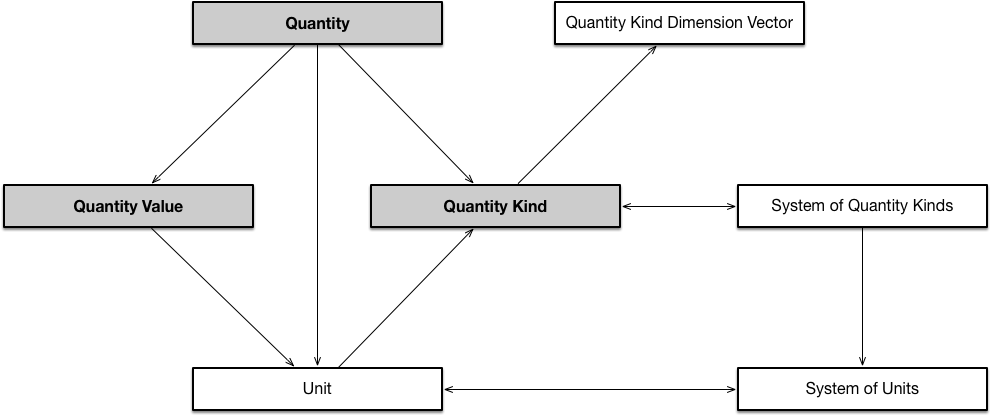
    A Quantity Kind is any observable property that can be measured and quantified numerically. Familiar examples include physical properties such as length, mass, time, force, energy, power, electric charge, etc. Less familiar examples include currency, interest rate, price to earning ratio, and information capacity.

    Unit of Measure

    A Unit of Measure or Unit is a particular quantity of a given kind that has been chosen as a scale for measuring other quantities of the same kind. For example, the Meter is a quantity of length that has been empirically defined by the BIPM. Any quantity of length can be expressed as a number multiplied by the unit meter.

    More formally, the value of a quantity Q with respect to a unit (U) is expressed as the scalar multiple of a real number (n) and U:

    Q = nU

    Quantity Value

    A quantity value expresses the numerical value of a quantity with respect to a chosen unit of measure. For example, the value of Planck's constant in Joule-Seconds (J s) is approximately 6.62606896E-34, whereas the value in Erg-Seconds (erg s) is approximately 6.62606896E-27.

    The OWL model for the classes qudt:QuantityKind, qudt:Quantity, qudt:QuantityValue, qudt:Unit is shown below.

    Systems of Quantities and Units

    The art and science of defining, standardizing, and organizing quantity kinds and units is ancient and modern. Today, scientific boards and standards bodies maintain rigorous definitions for quantity kinds and units. The definitions of quantity kinds and their relationships are derived from physical laws and mathematical transformations. Units are defined by experimental observations, by the application of physical laws, as ratios of fundamental physical constants, or by reference. One significant advance in the modern treatment of metrology has been the use of logic and mathematics to organize quantity kinds and units into systems and to analyze the relationships between them.

    A system of quantity kinds is a set of one or more quantity kinds together with a set of zero or more algebraic equations that define relationships between quantity kinds in the set. In the physical sciences, the equations relating quantity kinds are typically physical laws and definitional relations, and constants of proportionality. Examples include Newton’s First Law of Motion, Coulomb’s Law, and the definition of velocity as the instantaneous change in position.

    In almost all cases, the system identifies a subset of base quantity kinds. The base set is chosen so that all other quantity kinds of interest can be derived from the base quantity kinds and the algebraic equations.

    A system of units is a set of units which are chosen as the reference scales for some set of quantity kinds together with the definitions of each unit. Units may be defined by experimental observation or by proportion to another unit not included in the system. If the unit system is explicitly associated with a quantity kind system, then the unit system must define at least one unit for each quantity kind.

    Base and Derived Quantity Kinds

    Many systems of quantity kinds identify a special subset of the included quantity kinds called the base quantity kinds. Base quantity kinds are typically chosen so that no base quantity kind can be expressed as an algebraic relation of one or more other base quantity kinds using only the constituent equations included in the system. A quantity kind that can be expressed as an algebraic relation of one or more base quantity kind is called a derived quantity kind. Thus, in any quantity kind system, the base set and derived set are disjoint.

    Similarly, unit systems may distinguish between base units and derived units. A base unit is a unit of measurement for a base quantity, and a derived unit is a unit of measurement for a derived quantity. Unit systems define at least one base unit for each base quantity and at least one derived unit for each derived quantity.

    Quantity Dimensions

    Quantity kind systems that define base and derived sets have certain mathematical properties that permit quantity kinds to be manipulated symbolically. The construction goes as follows: Assign a distinct dimension symbol to each base quantity kind. For each derived quantity kind, take the formula that expresses it in terms of the base quantity kinds and replace every occurrence of a base quantity with its symbol. This is the dimension symbol for the derived quantity kind. In this way, every quantity kind maps to a dimension symbol of the form:

    dim Q = (B1)d1(B2)d2…(Bn)dn

    Here {B1,…,Bn} are the dimension symbols for the base quantities and {d1,…,dn} are rational numbers. Typically, the values of the di are between -3 and 3, however magnitudes as high as 7 are required to cover the range of quantity kinds currently defined. Using the multiplication identity for exponents AnAm = An+m one can show that the set of dimension symbols is homomorphic to an n-dimensional vector space over the rational numbers. Multiplication of quantity kinds corresponds to vector addition, division corresponds to vector subtraction, and inverting a quantity kind corresponds to computing the additive inverse of its dimension vector.

    In some cases, distinct quantity kinds may have the same dimension symbol. This often occurs in cases where physical laws are discovered and formalized independently of each other, but reduce to the same base quantity kinds. A commonly quoted example is the dimensional equivalence of mechanical torque and energy. Both have the same dimensions (L2M1T-2) but are defined very differently.

    One consequence of the equivalence is that the same units of measure are applicable to both. A salient difference between the two in this example is that torque is a pseudo-vector while energy is a scalar. However, this distinction (value type) is not accounted for in the quantity kind system formalism.

    The OWL model of Dimensions is illustrated below.

    Dimensionless Quantities and Units

    Dimensionless Quantities, or quantities of dimension 1, are those for which all the exponents of the factors corresponding to the base quantities in its quantity dimension are zero. Counts, ratios and plane angles are examples of dimensionless quantities.

    Allowed Units

    Some unit systems identify units that are not defined within the system but are allowed to be used in combination with units that are defined within the system. Allowed units must be commensurable with some defined unit of the system, so that quantities expressed in the allowed unit may be converted to a defined unit. The SI System explicitly allows a number of non-SI units.

    Example Quantity Kind and Unit Systems

    This section contains tables of several of the quantity kind and unit systems that are currently defined in the ontology. The table columns are:

    The SI System

    SI Base and Derived Quantities and Units

    Category

    Quantity Kind

    QName

    Dimension Symbol

    Unit

    QName

    Unit Symbol

    Base

    Dimensionless

    quantity:Dimensionless

    U

    Unity

    unit:Unity

    U

    Length

    qunatity:Length

    L

    Meter

    unit:Meter

    m

    Mass

    quantity:Mass

    M

    Kilogram

    unit:Kilogram

    kg

    Time

    quantity:Time

    T

    Second

    unit:SecondTime

    s

    Electric Current

    quantity:ElectricCurrent

    I

    Ampere

    unit:Ampere

    A

    Temperature

    quantity:ThermodynamicTemperature

    Θ

    Kelvin

    unit:Kelvin

    K

    Amount of Substance

    quantity:AmountOfSubstance

    N

    Mole

    unit:Mole

    mol

    Luminous Intensity

    quantity:LuminousIntensity

    J

    Candela

    unit:Candela

    cd

    Derived

    Absorbed Dose

    quantity:AbsorbedDose

    L2T-2

    Gray

    unit:Gray

    Gy

    Absorbed Dose Rate

    quantity:AbsorbedDoseRate

    L2T-3

    Gray per second

    unit:GrayPerSecond

    Gy/s

    Activity

    quantity:Activity

    T-1

    Becquerel

    unit:Becquerel

    Bq

    Amount of Substance Per Unit Volume

    quantity:AmountOfSubstancePerUnitVolume

    L-3N1

    Mole per cubic meter

    unit:MolePerCubicMeter

    mol/m^3

    Amount of Substance per Unit Mass

    quantity:AmountOfSubstancePerUnitMass

    M-3N1

    Mole per kilogram

    unit:MolePerKilogram

    mol/kg

    Angular Acceleration

    quantity:AngularAcceleration

    U1T-2

    Radian per second squared

    unit:RadianPerSecondSquared

    rad/s^2

    Angular Mass

    quantity:AngularMass

    L2M1

    Kilogram Meter Squared

    unit:KilogramMeterSquared

    kg-m^2

    Angular Momentum

    quantity:AngularMomentum

    L2M1T-1

    Joule Second

    unit:JouleSecond

    J s

    Angular Velocity

    quantity:AngularVelocity

    U1T-1

    Radian per second

    unit:RadianPerSecond

    rad/s

    Area

    quantity:Area

    L2

    Square meter

    unit:SquareMeter

    m^2

    Area Angle

    quantity:AreaAngle

    U1L2

    Square meter steradian

    unit:SquareMeterSteradian

    m^2-sr

    Area Temperature

    quantity:AreaTemperature

    L2Θ1

    Square meter kelvin

    unit:SquareMeterKelvin

    m^2-K

    Area Thermal Expansion

    quantity:AreaThermalExpansion

    L2Θ-1

    Square meter per kelvin

    unit:SquareMeterPerKelvin

    m^2/K

    Capacitance

    quantity:Capacitance

    L-2M-1T4I2

    Farad

    unit:Farad

    F

    Catalytic Activity

    quantity:CatalyticActivity

    T-1N1

    Katal

    unit:Katal

    kat

    Coefficient of Heat Transfer

    quantity:CoefficientOfHeatTransfer

    M1T-3Θ-1

    Watt per square meter kelvin

    unit:WattPerSquareMeterKelvin

    W/(m^2-K)

    Density

    quantity:Density

    L-3M1

    Kilogram per cubic meter

    unit:KilogramPerCubicMeter

    kg/m^3

    Dose Equivalent

    quantity:DoseEquivalent

    L2T-2

    Sievert

    unit:Sievert

    Sv

    Dynamic Viscosity

    quantity:DynamicViscosity

    L-1M1T-1

    Pascal second

    unit:PascalSecond

    Pa-s

    Electric Charge

    quantity:ElectricCharge

    T1I1

    Coulomb

    unit:Coulomb

    C

    Electric Charge Line Density

    quantity:ElectricChargeLineDensity

    L-1T1I1

    Coulomb per meter

    unit:CoulombPerMeter

    C/m

    Electric Charge Volume Density

    quantity:ElectricChargeVolumeDensity

    L-3T1I1

    Coulomb per cubic meter

    unit:CoulombPerCubicMeter

    C/m^3

    Electric Charge per Amount of Substance

    quantity:ElectricChargePerAmountOfSubstance

    T1I1N-1

    Coulomb per mole

    unit:CoulombPerMole

    C/mol

    Electric Current Density

    quantity:ElectricCurrentDensity

    L-2I1

    Ampere per square meter

    unit:AmperePerSquareMeter

    A/m^2

    Electric Current per Angle

    quantity:CurrentPerAngle

    U-1I1

    Ampere per radian

    unit:AmperePerRadian

    A/rad

    Electric Dipole Moment

    quantity:ElectricDipoleMoment

    L1T1I1

    Coulomb meter

    unit:CoulombMeter

    C-m

    Electric Field Strength

    quantity:ElectricFieldStrength

    L1M1T-3I-1

    Volt per Meter

    unit:VoltPerMeter

    V/m

    Electric Flux Density

    quantity:ElectricFluxDensity

    L-2T1I1

    Coulomb per Square Meter

    unit:CoulombPerSquareMeter

    C/m^2

    Electrical Conductivity

    quantity:ElectricalConductivity

    L-2M-1T3I2

    Siemens

    unit:Siemens

    S

    Electromotive Force

    quantity:ElectromotiveForce

    L2M1T-3I-1

    Volt

    unit:Volt

    V

    Energy Density

    quantity:EnergyDensity

    L-1M1T-2

    Joule per cubic meter

    unit:JoulePerCubicMeter

    J/m^3

    Energy and Work

    quantity:EnergyAndWork

    L2M1T-2

    Joule

    unit:Joule

    J

    Energy per Unit Area

    quantity:EnergyPerUnitArea

    M1T-2

    Joule per square meter

    unit:JoulePerSquareMeter

    J/m^2

    Exposure

    quantity:Exposure

    M-1T1I1

    Coulomb per kilogram

    unit:CoulombPerKilogram

    C/kg

    Force

    quantity:Force

    L1M1T-2

    Newton

    unit:Newton

    N

    Force per Electric Charge

    quantity:ForcePerElectricCharge

    L1M1T-3I-1

    Newton per coulomb

    unit:NewtonPerCoulomb

    N/C

    Force per Unit Length

    quantity:ForcePerUnitLength

    M1T-2

    Newton per meter

    unit:NewtonPerMeter

    N/m

    Frequency

    quantity:Frequency

    T-1

    Hertz

    unit:Hertz

    Hz

    Inverse second time

    quantity:InverseSecondTime

    s^-1

    Gravitational Attraction

    quantity:GravitationalAttraction

    L3M-1T-2

    Cubic meter per kilogram second squared

    unit:CubicMeterPerKilogramSecondSquared

    m^3/(kg-s^2)

    Heat Capacity and Entropy

    quantity:HeatCapacityAndEntropy

    L2M1T-2Θ-1

    Joule per kelvin

    unit:JoulePerKelvin

    J/K

    Heat Flow Rate

    quantity:HeatFlowRate

    L2M1T-3

    Watt

    unit:Watt

    W

    Heat Flow Rate per Unit Area

    quantity:HeatFlowRatePerUnitArea

    M1T-3

    Watt per square meter

    unit:WattPerSquareMeter

    W/m^2

    Illuminance

    quantity:Illuminance

    U1L-2J1

    Lux

    unit:Lux

    lx

    Inductance

    quantity:Inductance

    L2M1T-2I-2

    Henry

    unit:Henry

    H

    Inverse Amount of Substance

    quantity:InverseAmountOfSubstance

    N-1

    Per mole

    unit:PerMole

    mol^(-1)

    Inverse Permittivity

    quantity:InversePermittivity

    L3M1T-4I-2

    Meter per farad

    unit:MeterPerFarad

    m/F

    Kinematic Viscosity

    quantity:KinematicViscosity

    L2T-1

    Square meter per second

    unit:SquareMeterPerSecond

    m^2/sec

    Length Mass

    quantity:LengthMass

    L1M1

    Meter kilogram

    unit:MeterKilogram

    m-kg

    Length Temperature

    quantity:LengthTemperature

    L1Θ1

    Meter kelvin

    unit:MeterKelvin

    m-K

    Linear Acceleration

    quantity:LinearAcceleration

    L1T-2

    Meter per second squared

    unit:MeterPerSecondSquared

    m/s^2

    Linear Momentum

    quantity:LinearMomentum

    L1M1T-1

    Kilogram Meter Per Second

    unit:KilogramMeterPerSecond

    kg-m/s

    Linear Thermal Expansion

    quantity:LinearThermalExpansion

    L1Θ-1

    Meter per kelvin

    unit:MeterPerKelvin

    m/K

    Linear Velocity

    quantity:LinearVelocity

    L1T-1

    Meter per second

    unit:MeterPerSecond

    m/s

    Luminance

    quantity:Luminance

    L-2J1

    Candela per square meter

    unit:CandelaPerSquareMeter

    cd/m^2

    Luminous Flux

    quantity:LuminousFlux

    U1J1

    Lumen

    unit:Lumen

    lm

    Magnetic Dipole Moment

    quantity:MagneticDipoleMoment

    L2I1

    Joule per Tesla

    unit:JoulePerTesla

    J/T

    Magnetic Field Strength

    quantity:MagneticFieldStrength

    L-1I1

    Ampere Turn per Meter

    unit:AmpereTurnPerMeter

    At/m

    Ampere per meter

    quantity:AmperePerMeter

    A/m

    Magnetic Flux

    quantity:MagneticFlux

    L2M1T-2I-1

    Weber

    unit:Weber

    Wb

    Magnetic Flux Density

    quantity:MagneticFluxDensity

    M1T-2I-1

    Tesla

    unit:Tesla

    T

    Magnetomotive Force

    quantity:MagnetomotiveForce

    U1I1

    Ampere Turn

    unit:AmpereTurn

    At

    Mass Temperature

    quantity:MassTemperature

    M1Θ1

    Kilogram kelvin

    unit:KilogramKelvin

    kg-K

    Mass per Time

    quantity:MassPerUnitTime

    M1T-1

    Kilogram per second

    unit:KilogramPerSecond

    kg/s

    Mass per Unit Area

    quantity:MassPerUnitArea

    L-2M1

    Kilogram per square meter

    unit:KilogramPerSquareMeter

    kg/m^2

    Mass per Unit Length

    quantity:MassPerUnitLength

    L-1M1

    Kilogram per meter

    unit:KilogramPerMeter

    kg/m

    Molar Energy

    quantity:MolarEnergy

    L2M1T-2N-1

    Joule per mole

    unit:JoulePerMole

    J/mol

    Molar Heat Capacity

    quantity:MolarHeatCapacity

    L2M1T-2Θ-1N-1

    Joule per mole kelvin

    unit:JoulePerMoleKelvin

    J/(mol-K)

    Permeability

    quantity:Permeability

    L1M1T-2I-2

    Henry per meter

    unit:HenryPerMeter

    H/m

    Permittivity

    quantity:Permittivity

    L-3M-1T4I2

    Farad per meter

    unit:FaradPerMeter

    F/m

    Plane Angle

    quantity:PlaneAngle

    U1

    Radian

    unit:Radian

    rad

    Power

    quantity:Power

    L2M1T-3

    Watt

    unit:Watt

    W

    Power per Angle

    quantity:PowerPerAngle

    U-1L2M1T-3

    Watt per steradian

    unit:WattPerSteradian

    W/sr

    Power per Area Angle

    quantity:PowerPerAreaAngle

    U-1M1T-3

    Watt per square meter steradian

    unit:WattPerSquareMeterSteradian

    W/(m^2-sr)

    Power per Unit Area

    quantity:PowerPerUnitArea

    M1T-3

    Watt per square meter

    unit:WattPerSquareMeter

    W/m^2

    Pressure or Stress

    quantity:PressureOrStress

    L-1M1T-2

    Pascal

    unit:Pascal

    Pa

    Resistance

    quantity:Resistance

    L2M1T-3I-2

    Ohm

    unit:Ohm

    Ohm

    Solid Angle

    quantity:SolidAngle

    U1

    Steradian

    unit:Steradian

    sr

    Specific Energy

    quantity:SpecificEnergy

    L2T-2

    Joule per kilogram

    unit:JoulePerKilogram

    J/kg

    Specific Heat Capacity

    quantity:SpecificHeatCapacity

    L2T-2Θ-1

    Joule per kilogram kelvin

    unit:JoulePerKilogramKelvin

    J/(kg-K)

    Specific Heat Pressure

    quantity:SpecificHeatPressure

    L3M-1Θ-1

    Joule per kilogram kelvin per pascal

    unit:JoulePerKilogramKelvinPerPascal

    J/(km-K-Pa)

    Specific Heat Volume

    quantity:SpecificHeatVolume

    L-1T-2Θ-1

    Joule per kilogram kelvin per cubic meter

    unit:JoulePerKilogramKelvinPerCubicMeter

    J/(kg-K-m^3)

    Temperature Amount of Substance

    quantity:TemperatureAmountOfSubstance

    Θ1N1

    Mole kelvin

    unit:MoleKelvin

    mol-K

    Thermal Conductivity

    quantity:ThermalConductivity

    L1M1T-3Θ-1

    Watt per meter kelvin

    unit:WattPerMeterKelvin

    W/(m*K)

    Thermal Diffusivity

    quantity:ThermalDiffusivity

    L2T-1

    Square meter per second

    unit:SquareMeterPerSecond

    m^2/sec

    Thermal Insulance

    quantity:ThermalInsulance

    M-1T3Θ1

    Square meter Kelvin per watt

    unit:SquareMeterKelvinPerWatt

    (K^2)m/W

    Thermal Resistance

    quantity:ThermalResistance

    L-2M-1T3Θ1

    Kelvin per watt

    unit:KelvinPerWatt

    K/W

    Thermal Resistivity

    quantity:ThermalResistivity

    L-1M-1T3Θ1

    Meter Kelvin per watt

    unit:MeterKelvinPerWatt

    K-m/W

    Thrust to Mass Ratio

    quantity:ThrustToMassRatio

    L1T-2

    Newton per kilogram

    unit:NewtonPerKilogram

    N/kg

    Time Squared

    quantity:TimeSquared

    T2

    Second time squared

    unit:SecondTimeSquared

    s^2

    Torque

    quantity:BendingMomentOrTorque

    L2M1T-2

    Newton meter

    unit:NewtonMeter

    N-m

    Volume

    quantity:Volume

    L3

    Cubic Meter

    unit:CubicMeter

    m^3

    Volume Thermal Expansion

    quantity:VolumeThermalExpansion

    L3Θ-1

    Cubic meter per kelvin

    unit:CubicMeterPerKelvin

    m^3/K

    Volume per Unit Time

    quantity:VolumePerUnitTime

    L3T-1

    Cubic meter per second

    unit:CubicMeterPerSecond

    m^3/s

    Volumetric heat capacity

    quantity:VolumetricHeatCapacity

    L-1M1T-2Θ-1

    Joule per cubic meter kelvin

    unit:JoulePerCubicMeterKelvin

    J/(m^3 K)


    The CGS System

    CGS Base and Derived Quantity Kinds and Units

    Category

    Quantity Kind

    QName

    Dimension Symbol

    Unit

    QName

    Unit Symbol

    Base

    Dimensionless

    quantity:Dimensionless

    U

    Unity

    unit:Unity

    U

    Length

    quantity:Length

    L

    Centimeter

    unit:Centimeter

    cm

    Mass

    quantity:Mass

    M

    Gram

    unit:Gram

    g

    Time

    quantity:Time

    T

    Second

    unit:SecondTime

    s

    Derived

    Angular Momentum

    quantity:AngularMomentum

    L2M1T-1

    Erg second

    unit:ErgSecond

    erg s

    Area

    quantity:Area

    L2

    Square centimeter

    unit:SquareCentimeter

    cm^2

    Dynamic Viscosity

    quantity:DynamicViscosity

    L-1M1T-1

    Poise

    unit:Poise

    P

    Energy Density

    quantity:EnergyDensity

    L-1M1T-2

    Erg per cubic centimeter

    unit:ErgPerCubicCentimeter

    erg/cm^3

    Energy and Work

    quantity:EnergyAndWork

    L2M1T-2

    Erg

    unit:Erg

    erg

    Force

    quantity:Force

    L1M1T-2

    Dyne

    unit:Dyne

    dyn

    Frequency

    quantity:Frequency

    T-1

    Inverse second time

    unit:InverseSecondTime

    s^-1

    Linear Acceleration

    quantity:LinearAcceleration

    L1T-2

    Centimeter per second squared

    unit:CentimeterPerSecondSquared

    cm/s^2

    Linear Velocity

    quantity:LinearVelocity

    L1T-1

    Centimeter per second

    unit:CentimeterPerSecond

    cm/s

    Power

    quantity:Power

    L2M1T-3

    Erg per second

    unit:ErgPerSecond

    erg/s

    Power per Unit Area

    quantity:PowerPerUnitArea

    M1T-3

    Erg per square centimeter second

    unit:ErgPerSquareCentimeterSecond

    erg/(cm^2-s)

    Pressure or Stress

    quantity:PressureOrStress

    L-1M1T-2

    Dyne per square centimeter

    unit:DynePerSquareCentimeter

    dyn/cm^2

    Time Area

    quantity:TimeArea

    L2T1

    Square centimeter second

    unit:SquareCentimeterSecond

    cm^2-s

    Torque

    quantity:BendingMomentOrTorque

    L2M1T-2

    Dyne centimeter

    unit:DyneCentimeter

    dyn-cm

    Volume

    quantity:Volume

    L3

    Cubic Centimeter

    unit:CubicCentimeter

    cm^3


    CGS Units for Electricity and Magnetism

    There are two different approaches to defining electric and magnetic quantities using the base CGS mechanical quantities of length, mass and time. The Electromagnetic Unit (EMU) approach derives electric charge from Coulomb’s Law, while the Electrostatic Unit (ESU) approach derives electric charge from Ampere’s Law.

    EMU Derived Units

    Coulomb’s Law states that the force exerted between two charged particles, q1 and q2, is inversely proportional to the square of their distance, r.

    F=k(q1q2)/r2

    Retaining only the terms of the quantity kinds involved (force, electric charge, distance), this equation can be rearranged to express electric charge as length multiplied by the square root of force. The CGS Electromagnetic Unit is called the Abcoulomb. The table below contains the dimension symbols and corresponding units of other electricity and magnetism quantity kinds in terms of the base CGS quantity kinds and the definition of electric charge above.

    CGS EMU Derived Units for Electricity and Magnetism

    Quantity Kind

    QName

    Dimension Symbol

    Unit

    QName

    Unit Symbol

    Capacitance

    quantity:Capacitance

    L-1T2

    Abfarad

    unit:Abfarad

    abF

    Electric Charge

    quantity:ElectricCharge

    L0.5M0.5

    Abcoulomb

    unit:Abcoulomb

    abC

    Electric Current

    quantity:ElectricCurrent

    L0.5M0.5T-1

    Abampere

    unit:Abampere

    abA

    Electric Field Strength

    quantity:ElectricFieldStrength

    L0.5M0.5T-2

    Abvolt per Centimeter

    unit:AbvoltPerCentimeter

    abV/cm

    Electric Flux Density

    quantity:ElectricFluxDensity

    L-1.5M0.5

    Abcoulomb per square centimeter

    unit:AbcoulombPerSquareCentimeter

    abC/cm^2

    Electrical Conductivity

    quantity:ElectricalConductivity

    L-1T1

    Absiemen

    unit:Absiemen

    aS

    Electromotive Force

    quantity:ElectromotiveForce

    L1.5M0.5T-2

    Abvolt

    unit:Abvolt

    abV

    Inductance

    quantity:Inductance

    L1

    Abhenry

    unit:Abhenry

    abH

    Magnetic Field Strength

    quantity:MagneticFieldStrength

    L-0.5M0.5T-1

    Abtesla

    unit:Abtesla

    abT

    Magnetic Flux

    quantity:MagneticFlux

    L1.5M0.5T-1

    Abvolt Second

    unit:AbvoltSecond

    abV-s

    Magnetic Flux Density

    quantity:MagneticFluxDensity

    L-0.5M0.5T-1

    Abtesla

    unit:Abtesla

    abT

    Magnetomotive Force

    quantity:MagnetomotiveForce

    L0.5M0.5T-1

    Gilbert

    unit:Gilbert

    Gi

    Permeability

    quantity:Permeability

    U1

    Relative permeability

    unit:RelativePermeability

    μ r

    Permittivity

    quantity:Permittivity

    L-2T2

    Abfarad per centimeter

    unit:AbfaradPerCentimeter

    abF/cm

    Resistance

    quantity:Resistance

    L1T-1

    Abohm

    unit:Abohm

    abOhm

    ESU Derived Units

    Ampere’s Law of Magnetic Induction states that the force per unit length exerted between two infinite parallel wires at a distince, d, and carrying electric currents I1 and I2 is proportional to their product divided by the distance between them. I.e.

    dF/dl = k(I1I2/d)

    Retaining only the terms of the quantity kinds involved (force, electric current, distance), this equation can be rearranged to express electric current as the square root of force. The CGS Electrostatic Unit of electric current is called the Statampere. The table below contains the dimension symbols and corresponding units of other electricity and magnetism quantity kinds in terms of the base CGS quantity kinds and the definition of electric current above.

    CGS ESU Derived Units for Electricity and Magnetism

    Quantity Kind

    QName

    Dimension Symbol

    Unit

    QName

    Unit Symbol

    Capacitance

    quantity:Capacitance

    L1

    Statfarad

    unit:Statfarad

    statF

    Electric Charge

    quantity:ElectricCharge

    L1.5M0.5T-1

    Statcoulomb

    unit:Statcoulomb

    statC

    Electric Current

    quantity:ElectricCurrent

    L1.5M0.5T-2

    Statampere

    unit:Statampere

    statA

    Electric Field Strength

    quantity:ElectricFieldStrength

    L-0.5M0.5T-1

    Statvolt per centimeter

    unit:StatvoltPerCentimeter

    statV/cm

    Electric Flux Density

    quantity:ElectricFluxDensity

    L-0.5M0.5T-1

    Statcoulomb per square centimeter

    unit:StatcoulombPerSquareCentimeter

    statC/cm^2

    Electromotive Force

    quantity:ElectromotiveForce

    L0.5M0.5T-1

    Statvolt

    unit:Statvolt

    statV

    Inductance

    quantity:Inductance

    L-1T2

    Stathenry

    unit:Stathenry

    statH

    Magnetic Field Strength

    quantity:MagneticFieldStrength

    L0.5M0.5T-2

    Oersted

    unit:Oersted

    Oe

    Magnetic Flux

    quantity:MagneticFlux

    L0.5M0.5

    Maxwell

    unit:Maxwell

    Mx

    Magnetic Flux Density

    quantity:MagneticFluxDensity

    L-1.5M0.5

    Gauss

    unit:Gauss

    G

    Magnetomotive Force

    quantity:MagnetomotiveForce

    L1.5M0.5T-2

    Oersted centimeter

    unit:OerstedCentimeter

    Oe-cm

    Permeability

    quantity:Permeability

    L-2T2

    Stathenry per centimeter

    unit:StathenryPerCentimeter

    statH/cm

    Permittivity

    quantity:Permittivity

    U1

    Relative permittivity

    unit:RelativePermittivity

    ε r

    Resistance

    quantity:Resistance

    L-1T1

    Statohm

    unit:Statohm

    statOhm

    Glossary

    NExIOM
    NASA Exploration Intiatives Ontology Models
    TBD
    To Be Done
    TBR
    To Be Revised

    Acknowledgements

    [TBR]

    1. NASA AMES Research Center for sponsoring and content for different engineering disciplines
    2. TopQuadrant, Inc., for Ontology Architecture, foundation ontologies and tooling support
    3. European Space Agency (ESA), for constructive dialog and input to the ontology models

    References

    1. The NIST Guide for the use of the International System of Units
    2. International Vocabulary of Metrology – Basic and General Concepts and Associated Terms
    3. SI Brochure, 8th Edition
    4. Dimensional Analysis, Percy Williams Bridgman, Yale University Press (1922)

    Last Updated September 11, 2011

    Creative Commons License
    This work is licensed under a Creative Commons Attribution-Share Alike 3.0 United States License.